Wired Different, Wanting Everything: How Disabled and Neurodivergent People Are Blowing Up the Intimacy Playbook
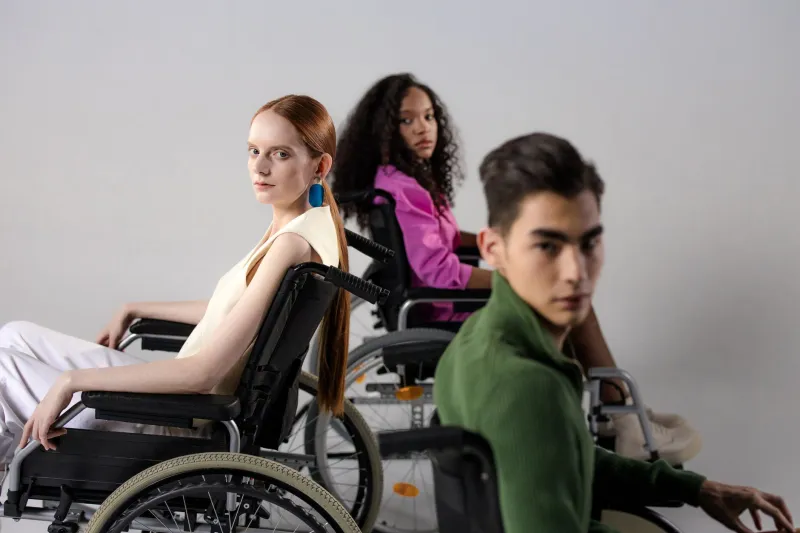
Here's a question nobody asks at the dinner table: What if the people society wrote off as "too complicated" for conventional romance are actually the ones who figured it out first?
Because that's what's happening. Quietly, persistently, and with a kind of creative ferocity that mainstream culture hasn't caught up to yet, disabled and neurodivergent folks are dismantling the standard-issue intimacy script — the one that assumes everyone has the same body, the same nervous system, the same capacity for touch, the same appetite for closeness — and replacing it with something far more interesting.
Something real.
The Script Nobody Asked For
Let's be honest about what conventional American intimacy culture actually looks like. It's a fairly narrow set of assumptions: that sex is primarily physical in one specific way, that desire is spontaneous and linear, that good partners are always available and always responsive, that vulnerability is a stop on the way to something else rather than a destination in itself.
For a huge portion of the population, that script doesn't just fail to fit — it actively causes harm.
Samira, a 31-year-old disability rights organizer in Chicago who has Ehlers-Danlos Syndrome, describes the exhaustion of trying to squeeze herself into that mold for years. "I spent so long apologizing for my body," she says. "Apologizing for needing things. For having limits. For not being able to do it the way the movies said you were supposed to." The apology, she notes, was never actually about her. It was about protecting her partners from having to confront their own discomfort with difference.
She stopped apologizing around the same time she found community with other disabled people who were having completely different conversations about desire — conversations that started from the premise that their needs weren't problems to be solved, but information to be honored.
Access Is Foreplay
There's a phrase circulating in disability justice and sex-positive spaces that sounds provocative until you sit with it for a second: access is foreplay.
The idea, popularized by disability activists and educators like Mia Mingus, is that the work of making intimacy genuinely possible for someone — asking about their needs, learning their body's language, creating conditions where they can actually show up — isn't a bureaucratic hurdle before the real thing. It is the real thing. It's care made physical. It's attention as an erotic act.
For neurodivergent people especially — those navigating ADHD, autism, sensory processing differences, anxiety, or any number of other ways of being wired — this reframe hits different. Marcus, a 27-year-old in Austin who was diagnosed autistic at 22, says that the concept cracked something open for him. "I always thought the fact that I needed to know everything in advance, that I needed to communicate explicitly about touch and timing and what was okay — I thought that was a deficiency. Like I was doing intimacy wrong," he says. "And then someone pointed out that what I was actually doing was making space for real consent. I was just doing it more out loud."
The explicit communication that neurodivergent people often require — and that many disabled people have learned to insist on out of necessity — turns out to look a lot like best practices for everyone. The neurodivergent and disabled communities didn't invent enthusiastic consent culture, but they've been living it longer than most.
Desire Without a Template
One of the most radical things happening in these spaces is a full-scale renegotiation of what desire even means.
For people whose bodies don't conform to abled-bodied norms, the standard erotic vocabulary can feel like a foreign language. Chronic pain changes the calculus of physical intimacy entirely. Sensory sensitivities mean that certain kinds of touch that are supposed to feel good simply don't — and certain kinds that aren't supposed to matter feel electric. Energy limitations mean that intimacy has to be timed, paced, sometimes scheduled in ways that romantic mythology insists kills the magic.
Spoiler: it doesn't kill the magic. It relocates it.
Jordan, a 34-year-old sex educator in Portland who is both physically disabled and ADHD, runs workshops specifically for disabled and neurodivergent adults exploring sexuality. They describe watching participants have genuine revelations about their own desire — often for the first time — simply because the conversation started from a different place. "We don't begin with 'here's what sex looks like, now how do you fit into it,'" Jordan explains. "We begin with 'what does your body actually want? What does connection feel like for you specifically?' And people cry. Because nobody has ever asked."
The answers are wildly varied and consistently surprising. Some people discover that their most profound experiences of intimacy are non-physical. Some find that sensory-specific forms of touch they'd been told were "weird" are actually the core of their erotic life. Some realize that the reason conventional intimacy always felt hollow was because it was designed for a body and nervous system they don't have.
Crip Sexuality as Cultural Critique
This isn't just personal. It's political.
The disability justice movement has long argued that the way society treats disabled bodies is a mirror of its deepest values — and nowhere is that more visible than in the domain of sexuality. Disabled people are routinely desexualized in mainstream culture, treated as either asexual by default or as objects of inspiration porn rather than as full human beings with complex inner lives and erotic selves.
Activists and scholars working in the space of "crip sexuality" — a term reclaimed with intention — are pushing back hard. They're arguing that the desexualization of disabled people isn't just personally harmful; it's a symptom of a culture that treats certain bodies as less than fully human. And they're building alternatives: community spaces, educational resources, advocacy organizations, and creative works that center disabled and neurodivergent desire as legitimate, valuable, and frankly overdue for celebration.
Organizations like the Sexual Health Alliance and independent educators around the country are beginning to incorporate disability competency into sex education and therapy training — slowly, imperfectly, but it's movement.
What the Rest of Us Can Learn
Here's the part where this stops being a story about a particular community and becomes a story about all of us.
The frameworks that disabled and neurodivergent people have developed out of necessity — radical communication, flexible definitions of intimacy, pleasure that doesn't require a specific body or a specific act, care as a form of desire — these aren't accommodations. They're upgrades.
A culture that learned to ask "what does your body actually need?" before assuming it knows. A culture that understood that scheduling intimacy isn't a failure of spontaneity but an act of respect. A culture that stopped treating explicit communication as a mood-killer and started treating it as the whole point.
Samira puts it plainly: "Disabled people have been doing the emotional and intellectual labor of reimagining intimacy forever, because we had to. And abled-bodied people are just now catching up to what we've known for years — that the standard script was never that good to begin with."
She's not wrong. The playbook is burning. And what's being written in its place is more honest, more generous, and more alive than anything that came before it.