Joy Is the Revolution: How Queer and Kink Communities Are Making Pleasure a Political Act
There's a particular kind of exhaustion that comes from spending your whole life editing yourself. Softening your voice in the elevator. Removing the photo from your desk before the client visit. Laughing off the joke because making a scene feels like too much. For a lot of queer people, for a lot of people in kink communities, for anyone whose desire doesn't fit neatly into the approved American story of love and sex and selfhood — that exhaustion is bone-deep.
So what happens when people decide, collectively, to stop?
What you get isn't just a party. What you get is a political movement.
The Respectability Trap
The dominant strategy for LGBTQ+ acceptance over the last few decades leaned hard into a specific argument: we're just like you. Same monogamy, same mortgages, same desire to coach little league and cry at rom-coms. It worked — in the narrow sense that it moved certain legal needles. Marriage equality. Don't Ask Don't Tell repeal. Incremental, real, hard-won.
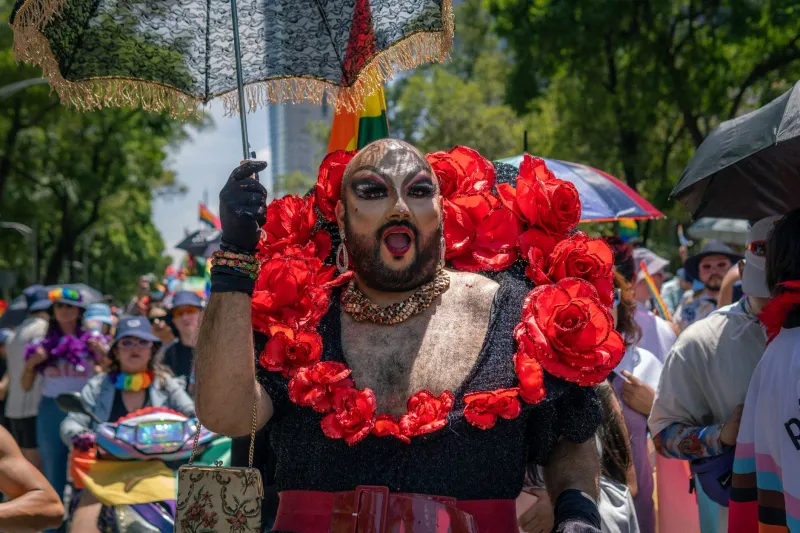
But a lot of people got left behind in that bargain. The trans women of color who actually threw the bricks at Stonewall didn't make the brochure. The leather daddies, the drag queens whose performances are too raunchy for prime time, the polyamorous queer households, the people whose sexuality is loud and weird and gloriously unfit for a sitcom — they were quietly asked to wait offstage while the respectable ones made the case.
"Assimilationism told us that if we could just prove we weren't threatening, they'd let us in," says Marcus, a Chicago-based organizer who runs workshops on queer pleasure politics. "But the price of admission was agreeing that the parts of us that were threatening — the parts that actually challenged how this culture thinks about sex and power and bodies — those had to go."
Pleasure activism — a term popularized by writer and facilitator adrienne maree brown — pushes back hard on that premise. The core idea is deceptively simple: the more you know what you want, the more you know what you're fighting for. Joy isn't the reward you get after liberation. Joy is the practice of liberation itself.
Hedonism as Refusal
Walk into any major leather or kink event — Folsom Street Fair in San Francisco, Leather Heartland in the Midwest, Black Rose in D.C. — and you're not just watching people have fun. You're watching a deliberate act of public defiance. These are spaces where visibility is the whole point. Where the thing you were told to hide becomes the thing you wear on the street, literally and otherwise.
"Every time someone shows up in their full self in a public space, they're doing something radical," says Dominique, a Black femme educator and event organizer based in Atlanta. "They're saying: I exist, I take up space, I will not be made small so that someone else can be comfortable."
Dominique runs pleasure-centered workshops specifically for queer people of color, a community she says faces a double bind — navigating both heteronormative pressure from outside and respectability politics from within. "There's this message in a lot of Black and brown communities that we have to be twice as proper, twice as contained, to earn our place. And I understand where that comes from historically. But it's also a form of internalized oppression, and it costs people their joy."
The workshops she facilitates aren't just about sex — though they don't shy away from it either. They're about identifying desire in the broadest sense. What do you actually want? What have you been trained to want instead? And what would it mean to pursue the real answer without apology?
Kink as Consent Culture's Sharpest Edge
Outside the LGBTQ+ community specifically, kink spaces have quietly been doing some of the most sophisticated work in America around consent, communication, and bodily autonomy — work that mainstream culture is only now starting to fumble toward in the wake of #MeToo.
"The kink community has been having explicit conversations about negotiation, boundaries, and aftercare for decades," says Riley, a sex educator and longtime member of the BDSM community in Seattle. "We developed a whole vocabulary for it because we had to. Nobody was going to hand us a framework."
Riley is quick to push back on the idea that kink is inherently transgressive for its own sake. "It's not about shock value. It's about intentionality. When you have to articulate what you want and what you don't want, when you have to actually listen to another person do the same thing — that's a radical departure from how most people were taught to think about sex."
That intentionality, that insistence on making the implicit explicit, is itself a form of political resistance in a culture that has historically treated women's and queer people's bodies as available by default and off-limits only when proven otherwise.
The Joy Gap
There's data, increasingly, to support what pleasure activists have been arguing from lived experience. Research on LGBTQ+ mental health consistently shows that community belonging and the freedom to express identity authentically are among the strongest protective factors against depression and anxiety. Shame, by contrast — the kind that gets internalized when you spend years shrinking yourself — is genuinely corrosive.
"We've been sold this idea that being strategic means being respectable," Marcus says. "But what's the point of winning rights on paper if the people those rights are supposed to protect are still living in shame? That's not liberation. That's just a more comfortable cage."
The pleasure activist answer isn't to abandon strategy. It's to insist that joy, visibility, and the refusal to be palatable are part of the strategy — not a distraction from it.
Building the World You Want Inside the One That Exists
What strikes you, talking to people doing this work, is how concrete it actually is. It's not abstract theorizing. It's people building spaces — physical and otherwise — where a different set of rules applies. Where you don't have to earn your place by making yourself smaller.
Dominique describes the moment in her workshops when something shifts. "People come in carrying so much. So much of what they've been told they can't be. And then they're in a room where nobody's asking them to perform normalcy, and you can just watch them exhale."
That exhale — that collective, physical release of a tension you've been holding so long you forgot it was there — might be the most radical thing happening in America right now.
Because if enough people remember what it feels like to want things and say so, to take up space without apology, to refuse the bargain that asks you to trade your whole self for conditional acceptance — the culture doesn't just shift at the margins.
It breaks open entirely.
And that, as it turns out, is exactly the point.