The Secret Schoolhouse: Inside America's Underground Revolution in Pleasure, Consent, and Bodily Power
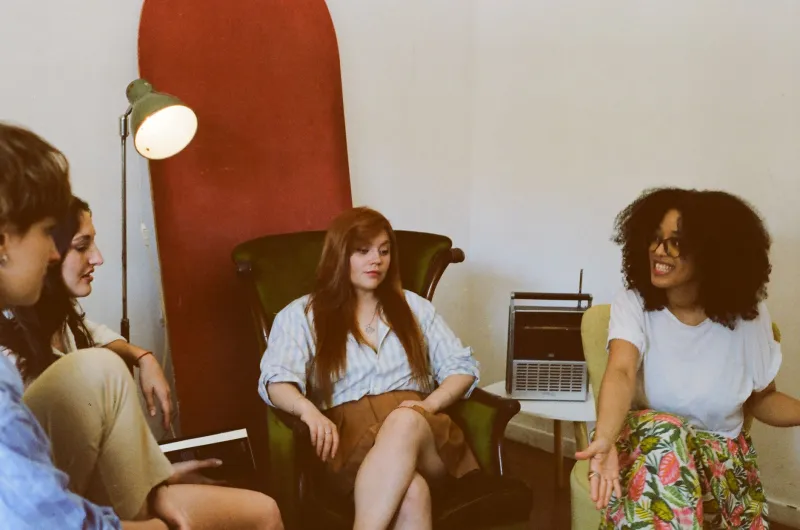
The address arrives 48 hours before the event. A Signal message, a cross street, a color-coded door. You show up to a brownstone in East Atlanta or a rented loft in Portland or someone's sprawling living room in Albuquerque, and what you find inside looks nothing like any classroom you've ever sat in. There are floor cushions and fairy lights, maybe a whiteboard, definitely snacks. And a facilitator — often someone who goes by a single name, who has no institutional affiliation, no university letterhead — ready to teach you things your entire formal education deliberately withheld.
This is the underground pleasure education movement. And it's growing faster than the institutions trying to ignore it.
What School Never Taught You (On Purpose)
Let's be real about something: American sex education has historically been less about education and more about containment. Abstinence-only curricula. Diagrams stripped of anything resembling pleasure. The clitoris — an entire organ — left off anatomical charts for decades. What most of us received wasn't information. It was a managed silence dressed up as health class.
The educators operating outside that system aren't filling a gap so much as blowing a hole through a wall. They're teaching consent as an ongoing, dynamic conversation rather than a checkbox. They're unpacking the neuroscience of arousal, the psychology of shame, the politics of who gets to feel pleasure without apology. They're doing it in spaces that deliberately exist beyond the reach of school boards, insurance requirements, and institutional liability.
"The moment you put this work inside a university or a nonprofit with a board of directors, you start making compromises," says one facilitator — we'll call her Soleil — who runs private salons in the Bay Area for groups of eight to twelve adults. "You start softening language. You start leaving out the parts that make funders uncomfortable. Out here, I don't have to do that."
The Salon as Classroom
The private salon model is one of the movement's most elegant workarounds. Borrowing loosely from the intellectual salons of 18th-century France — where thinkers gathered outside formal academies to actually say the unsayable — modern pleasure educators use intimate gatherings to create containers for conversations that larger institutions refuse to hold.
Topics vary wildly depending on the facilitator and the group. Some salons focus on embodied consent practices: participants learn to track their own nervous system responses, to distinguish a genuine yes from a fawning yes, to communicate desire without the performance of what desire is supposed to look like. Others go deep into trauma-informed frameworks, examining how stored experiences in the body shape arousal, aversion, and everything in between.
There are workshops specifically for survivors. Workshops for people in non-monogamous relationships navigating new emotional territory. Workshops for men — particularly men who've never had a single conversation about their own vulnerability or pleasure that wasn't wrapped in a punchline. The specificity is intentional. Generic education serves no one particularly well.
"People come in thinking they're going to learn techniques," says Marcus, a facilitator in Chicago who works primarily with queer and trans communities. "And sometimes we do talk about the physical stuff. But mostly what they're learning is how to be present in their own body without dissociating. That's the actual work."
Encrypted and Underground
Not all of this happens in person. A significant chunk of the movement lives in digital spaces that are deliberately hard to find — private Discord servers, encrypted Telegram groups, members-only newsletters that don't show up in any search result. The gatekeeping isn't elitism; it's protection.
Facilitators and participants alike describe a real fear of deplatforming, doxxing, and the broad sweep of content moderation policies that treat any frank discussion of sexuality as inherently obscene. FOSTA-SESTA, the 2018 federal legislation ostensibly aimed at sex trafficking, had a chilling effect far beyond its stated target — pushing sex educators, harm reduction workers, and adult content creators into increasingly precarious digital corners.
So they build their own corners. Password-protected curriculum libraries. Sliding-scale workshop registrations handled through personal Venmo or cash at the door. Community agreements signed at the beginning of every gathering, outlining confidentiality, consent to content, and the understanding that what happens in the room stays in the room.
It has the texture of a speakeasy. It shouldn't have to — but it does, and the people inside it have made a kind of peace with that.
Trauma-Informed Everything
One of the things that distinguishes this underground wave from earlier iterations of sexual liberation movements is an almost obsessive commitment to trauma-informed practice. The free love rhetoric of the '60s and '70s, for all its revolutionary energy, had a habit of steamrolling individual boundaries in the name of collective liberation. That shadow looms large over contemporary practitioners.
Modern underground educators tend to be deeply versed in somatic psychology, polyvagal theory, and the ways that trauma lives in the body rather than just the mind. They build in what they call "off-ramps" — moments of explicit check-in, permission to step out, structured ways to signal discomfort without disrupting the group. The goal isn't to push people past their edges. It's to help them find where their edges actually are, which turns out to be its own kind of radical act in a culture that rarely asks.
"We've been told so many stories about what we're supposed to want," says Dani, who facilitates workshops across the Southwest and identifies as a somatic practitioner. "The work is really just helping people get quiet enough to hear their own signal underneath all that noise."
The Politics of Who Gets to Feel Good
It would be naive to discuss pleasure education without naming who has historically been denied it most aggressively. The people flocking to these underground spaces are disproportionately women, queer and trans folks, people of color, disabled people, and survivors — precisely the communities whose desires have been most pathologized, policed, or simply erased from the cultural record.
There's a reason the facilitators in this movement talk about pleasure as a justice issue. Because access to bodily autonomy, to shame-free desire, to the basic knowledge that your nervous system is not broken — that access has never been equally distributed. Reclaiming it, for many participants, isn't just personal growth. It's something that feels a lot like repair.
"When I watch someone realize for the first time that they're allowed to want what they want," says Soleil, "that's not a small thing. That's someone getting back something that was taken from them. That matters beyond the bedroom. It matters everywhere."
The Risk Is the Point
There's something inherently bohemian about an education system that operates on trust, moves through word of mouth, and refuses to apologize for its subject matter. These aren't people waiting for permission. They're building the school that should have existed all along, in the spaces available to them, with the tools they have.
Is it perfect? No. Underground communities have their own power dynamics, their own blind spots, their own potential for harm. The absence of institutional oversight is a double-edged thing. The facilitators who do this work well know that, and they hold it carefully.
But in a country where a school board can still vote to remove accurate anatomy from a health curriculum, where a social media platform can delete a sex educator's decade of work overnight, where the official channels have failed so many bodies so completely — the secret schoolhouse starts to look less like a workaround and more like the whole point.
The address will come. The door will be the right color. And inside, someone will finally ask you what you actually want.

