Paint the Town Illegal: The Outlaws Turning America's Concrete Into Canvas
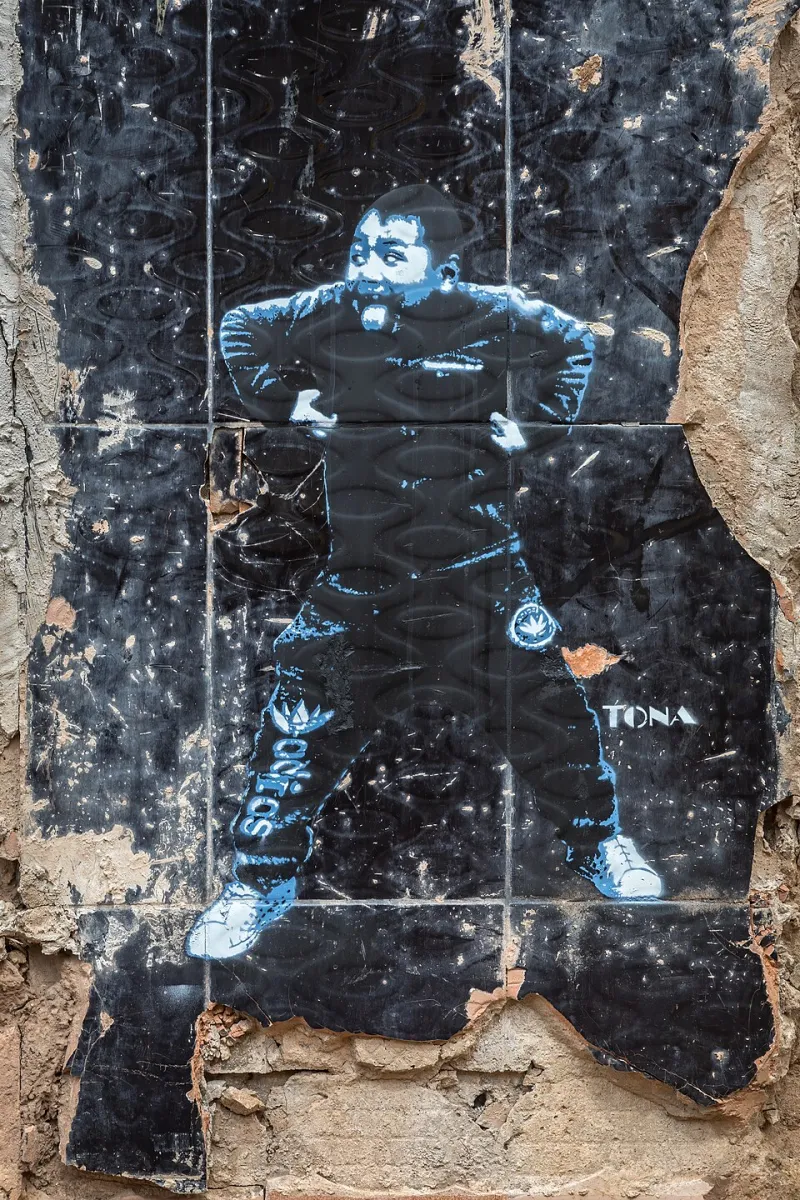
Photo: Tona, CC BY-SA 4.0, via Wikimedia Commons
It's 2 a.m. on a Tuesday in East Los Angeles, and a woman in paint-splattered overalls is standing in front of a twelve-foot concrete utility wall with a headlamp strapped to her forehead and a roller tray balanced on a milk crate. She has maybe ninety minutes before the neighborhood starts waking up. She's been planning this particular image for three weeks.
She didn't ask anyone's permission. She's not going to.
"The permit process is designed to make you palatable," she'll say later, over coffee, unwilling to give her full name for reasons that should be obvious. "By the time you've gotten approval from the city, the property owner, the neighborhood association — you've already compromised everything that made the idea worth doing."
This is the fundamental tension at the crashing, spray-painted heart of America's underground art scene: the moment you legitimize it, do you kill it?
Walls That Talk Back
Street art in the United States has a complicated relationship with its own history. What started as pure outlaw expression — New York subway cars in the 1970s, Philadelphia's aerosol writers, LA's cholo lettering traditions — has spent the last two decades being steadily absorbed into the cultural mainstream. Banksy gets museum retrospectives. KAWS collaborates with luxury brands. Cities that once prosecuted taggers now commission murals for tourism campaigns.
The institutionalization is real, and for many artists who came up in the underground, it's a source of genuine grief.
"There's a mural district in my city now," says Deshawn, a 31-year-old multi-disciplinary artist based in Detroit. "They have festivals. Corporate sponsors. It looks great on Instagram. And it has absolutely nothing to do with what drew me to painting walls in the first place."
What drew him, he explains, was the friction. The fact that the work existed in tension with the space around it. That it was uninvited, unmediated, and therefore genuinely confrontational.
"Sanctioned street art is just outdoor advertising with better aesthetics," he says. "It's been domesticated."
The New Underground Isn't What You Think
The contemporary wave of unauthorized public art has evolved well beyond spray cans and bubble letters — though those remain very much alive. What's happening now is more eclectic, more conceptually ambitious, and in many cases more deliberately ephemeral.
In Chicago, a collective known only as Gravel & Ghost has spent the past two years installing hand-cast ceramic tiles into the gaps of deteriorating sidewalks in underserved neighborhoods on the South Side. The tiles feature small, intricate imagery — a monarch butterfly, a child's hand, a burning building — and are set in mortar overnight, indistinguishable from city infrastructure by morning. Most have survived for months before being noticed or removed.
"We're not trying to be famous," says one member of the collective, a ceramicist who teaches at a community college under a different identity than the one she uses for the project. "We're trying to put something beautiful in a place that the city has decided doesn't deserve beauty. That's the whole statement."
In New York, an artist who goes by Vesper has been wheat-pasting large-scale photographic portraits of unhoused New Yorkers onto the facades of luxury condominiums in rapidly gentrifying neighborhoods — printed at billboard scale, installed overnight, gone within days when building management tears them down.
"The impermanence is the point," Vesper explains via encrypted message. "The building will be there for a hundred years. The portrait lasts four days. That's the piece."
The Legal Tightrope
Let's not romanticize the risk out of existence: unauthorized public art in the United States can carry real legal consequences. Depending on the jurisdiction, charges can range from misdemeanor vandalism to felony destruction of property, with potential fines running into the thousands and, in repeat-offense cases, actual jail time.
The calculus artists make varies enormously. Some work exclusively on abandoned or derelict surfaces, arguing — with some legal basis — that the harm calculus shifts when no active owner is maintaining the property. Others accept the risk as intrinsic to the work's meaning. A few have been arrested, prosecuted, and returned to the streets anyway.
"I've done the math," says Marco, a 26-year-old muralist in San Francisco's Mission District who has been cited twice and arraigned once. "The worst realistic outcome for me is a fine I can't afford and a record that makes my already difficult life marginally harder. The best outcome is that someone walks past something I made and feels seen for thirty seconds. I'll take that trade."
Not everyone has the same risk profile, of course. Artists of color, undocumented artists, and those with existing records navigate this landscape under vastly higher stakes than their white or more legally protected counterparts. The underground art scene, like most countercultural spaces, has its own unacknowledged hierarchies of safety.
When the Outlaw Becomes the Institution
The thornier philosophical question — the one that keeps coming up in conversations across this community — is what happens when the underground succeeds. When the guerrilla muralist gets the gallery show. When the collective gets the NEA grant. When the city that once prosecuted you commissions you to paint the side of a parking structure.
For some artists, that trajectory represents validation and survival. For others, it represents a kind of artistic death.
"I know painters who used to do incredible illegal work and now they only do permitted stuff," says Deshawn. "And the permitted stuff is technically more skilled. The scale is bigger. The resources are better. And it's completely, utterly lifeless. Because the risk was the oxygen."
This isn't a universal view. There are artists who argue that the dichotomy between legitimate and underground is itself a false one — that you can take the grant money and still make dangerous work, that the funding doesn't have to dictate the content.
"The wall doesn't know if you had permission," argues the ceramicist from Gravel & Ghost. "The work either does something or it doesn't. The paperwork is irrelevant."
Why It Matters Beyond the Art World
Strip away the aesthetic debates and the legal drama, and what the unauthorized public art movement is really arguing about is something more fundamental: Who does public space belong to?
In most American cities, the answer, in practice, is: property owners, municipal governments, and whoever can afford the permitting fees and liability insurance. The surfaces of cities are controlled, monetized, and allocated in ways that systematically exclude the people who actually inhabit them.
Guerrilla art — at its best, in its most intentional form — is a direct challenge to that arrangement. It's a claim staked on behalf of the idea that the visual environment of a city should reflect the full complexity of its population, not just the priorities of its wealthiest stakeholders.
It's messy. It's legally precarious. It occasionally produces work that's genuinely terrible. But it also produces moments of startling, unsanctioned beauty in places that have been told they don't deserve any — and in a culture that commodifies everything it touches, that might be the most radical act left.
Back in East Los Angeles, the woman with the headlamp packs up her supplies just before 4 a.m. The wall behind her now shows a figure — ambiguous, enormous, reaching upward — rendered in ochre and deep blue. By the time the neighborhood wakes up, it'll just be part of the landscape.
No signature. No Instagram tag. No permission.
Just the wall, talking back.